The water under the fog
How frailejones collect water from clouds, and why a good forecast has to listen to them.
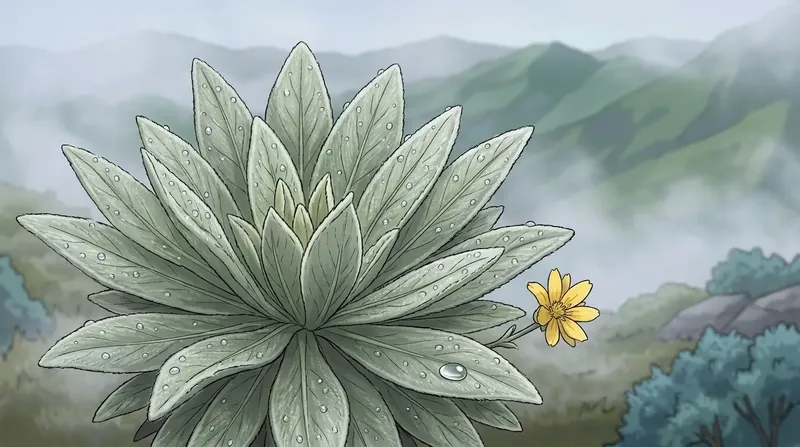
Walk up into a páramo before sunrise and you will notice that it is wet before it rains. The grass is wet. The moss is wet. The air itself seems to be holding something back. Above the tree line, where the Andes open into cold, treeless grassland, much of the water arrives sideways, as fog.
What a frailejón does
The frailejón is the plant that stands in that fog. Its leaves are thick, silver and covered in fine hairs, packed into a rosette that points at the sky. Fog settles on the hairs and condenses. Some of the water goes into the plant. Some drips to the soil below. Old leaves stay on the stem and wrap it like a coat, which keeps the plant warm and holds moisture close to the ground.
A single frailejón does not do much. A whole slope of them, over many decades, is a quiet kind of infrastructure.
A sponge, not a tank
Páramo soil is dark and thick, full of plant remains that decay slowly in the cold. It behaves like a sponge. In wet weeks it takes water in. In dry weeks it lets water go, a little at a time, into streams that begin as thin threads between the tussocks.
Much of what reaches Bogotá comes from systems like this one, Chingaza among them. By the time water arrives in the city, it has already been through the mountain.
That is why rain alone is a poor guide. A storm over a páramo does not become a river that afternoon. It becomes soil moisture, then a slow rise in a stream, then, weeks later, something a reservoir can feel. The mountain has a memory, and the memory is physical: how full the sponge already was when the rain came.
Listening for the memory
This is the problem we work on at Páramo. A rain gauge tells you what fell. A satellite tells you where the clouds sat and how green the ground looks. Neither tells you how much the soil kept.
So we put small sensors in the páramo, beside the frailejones, and ask them plain questions. How wet is the ground? How thick was the fog last night? How high is the stream at its source?
Those readings go in alongside satellite and rainfall records. A model learns how this particular mountain answers a dry month or a wet one. Then it gives a forecast for 7, 30 and 90 days, with a range, because mountains are not machines and we would rather be honest than tidy.
Why bother with fog
Fog is quiet water. It rarely fills a gauge in a way anyone notices, and it never makes the news. But in a páramo it may be part of what keeps a stream running through a dry spell. We do not claim to measure all of it. We measure enough to see when the mountain is giving more, or less, than it gave last year.
The people downstream do not need to understand condensation. They need to know whether the reservoir will hold until April, whether to plant now or wait, whether to ask neighbors to use a little less. Our job is to carry what the frailejón knows down the mountain, and to put it in a form someone can act on before the tap feels it.